
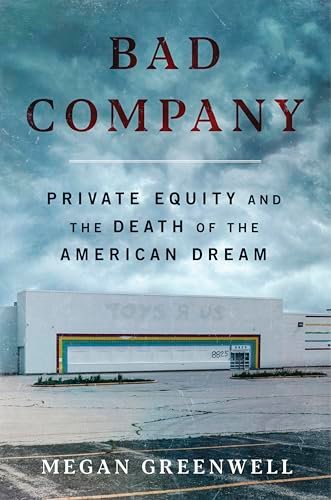
Book Review: Bad Company: Private Equity and the Death of the American Dream by Ainsley Greenwell
When I first spotted Bad Company: Private Equity and the Death of the American Dream by Ainsley Greenwell, I was drawn in by its audacious title. It echoed a common sentiment many of us feel: that the very fabric of American capitalism is fraying under the weight of greed. As a curious reader, I was eager to dive into the exploration of private equity, a subject often shrouded in mystique and controversy. Yet, much to my disappointment, what I uncovered was a murky mix of moral outrage dressed up as investigative journalism.
Greenwell’s thesis is straightforward: "private equity is bad." It’s a sentiment that could easily fit on a bumper sticker, but the problem lies in the fact that Greenwell stretches this rather simplistic notion over 300 pages. The book comes across as part op-ed, part Reddit thread—essentially a manifesto convinced of its own moral clarity. There’s a palpable sense of frustration in how the author attempts to paint private equity as the villain of modern capitalism, but instead, I found the writing bloated and often humorless. This isn’t to say there aren’t valid points in the narratives shared—stories about hospital closures or tenant struggles understandably evoke empathy—but the heavy reliance on anecdotes feels like rhetorical cudgels rather than a cohesive narrative.




As I navigated Greenwell’s prose, I was struck by her tone, which seemed less like that of a muckraker uncovering hidden truths and more akin to a Twitter activist with a book deal. Every villain is reduced to a caricature, while every victim stands as an avatar of righteous suffering. The complexity of issues around private equity—how firms operate, their historical context, and the policies that allowed them to thrive—are glossed over, replaced with a moral outrage that lacks nuance. It left me yearning for a more substantial economic framework in which to understand the deep-rooted issues at play.
What resonated with me, however, were the glimpses of Greenwell’s keen observations regarding the human cost of financial practices. Despite the narrative’s shortcomings, her ability to highlight suffering is commendable. Yet, one cannot help but wonder if the true loss here is not just the impact of private equity but the squandering of complexity and nuance in the storytelling itself. By the end of the book, I felt that this polemic preached to the choir while shying away from the vital conversations that need to take place.
In terms of writing style, while Greenwell’s passion is evident, the pacing often feels erratic. The repetition can be tiresome, yet I found myself reflecting on the broader implications of her message. Unfortunately, this reflection often weighed more on the simplistic conclusions rather than the structural insights that could have added depth to the narrative.
In conclusion, Bad Company may find its audience among those who share Greenwell’s clear concerns about the implications of private equity. However, for readers who seek a nuanced and analytical examination of economic systems, this book might not suffice. My reading experience was one of both frustration and contemplation, leaving me eager for a deeper exploration into how we can navigate the complexities of modern capitalism. If nothing else, it spurred me to seek out works that will elevate the discussion beyond moral binaries—because, in the end, understanding is key to meaningful change.
[ad_2]
Discover more about Bad Company: Private Equity and the Death of the Americ… on GoodReads >>